The SEC is racing Congress: three crypto rules move while the CLARITY Act stalls
With the Senate's market-structure bill stuck, the SEC penciled three crypto rulemakings into its July agenda — token offerings, custody, and trading venues. Whoever moves first writes the default.
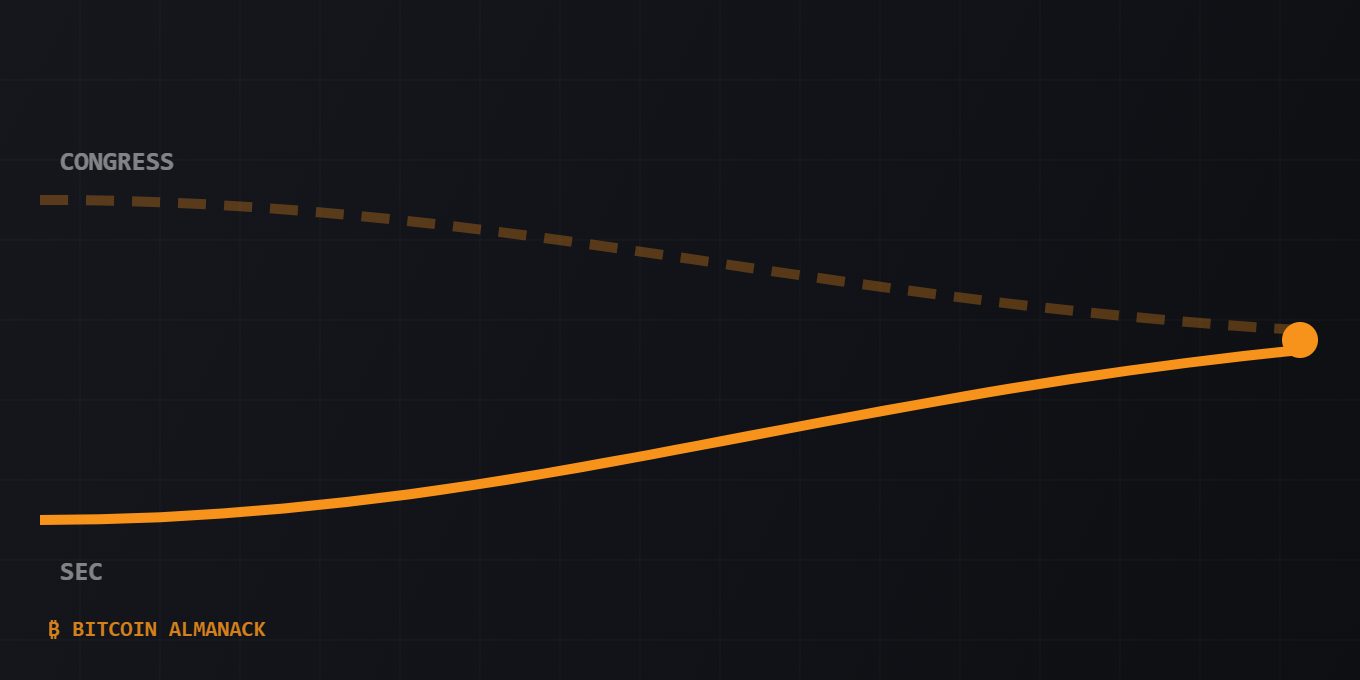
Two tracks to a U.S. crypto framework: Congress and the SEC. Illustration: Bitcoin Almanack.
Washington's crypto framework is being written on two tracks — and the slower one is the legislature. The SEC has set July targets for three crypto rulemaking proposals: how digital assets are offered and sold, broker-dealer requirements covering custody and recordkeeping, and market-structure rules for crypto trading venues. Meanwhile the CLARITY Act — the market-structure bill that would settle jurisdiction by statute — missed its expected pre-July 4 Senate vote and remains stalled over DeFi, stablecoin-yield, and AML disputes.
The sequencing matters more than it sounds. The CLARITY Act, which passed the House with bipartisan support last July, would define most digital assets as commodities under CFTC jurisdiction and narrow the SEC's reach — Congress drawing the map. If the SEC publishes its proposals first, the map gets drawn in reverse: the industry engages with a live rulemaking docket, and any eventual statute has to accommodate rules already in motion. SEC Chair Paul Atkins has framed the agenda as bringing crypto products onshore with clear rules for capital raising, custody, and on-chain trading.
The groundwork was laid in March, when the SEC and CFTC issued a joint interpretation — the first under their new memorandum of understanding — establishing a token taxonomy and confirming that most crypto assets are not themselves securities, with bitcoin the clearest case. That interpretation ended the enforcement-first era; the July proposals are the constructive half: what regulated crypto offerings, custody, and venues should actually look like.
For bitcoin holders specifically, the stakes are concentrated in the custody rule. How broker-dealers may hold digital assets — and whether qualified-custody requirements accommodate self-custody and multisig arrangements — shapes everything from how exchanges safekeep customer coins to whether advisers can recommend bitcoin at all. The offerings and venue rules matter more for the token economy than for bitcoin, which trades as a commodity either way.
The backdrop is a rare political alignment: an administration that has pledged to make the U.S. the "crypto capital of the planet," a strategic bitcoin reserve holding roughly $29 billion, and midterm elections in November that could reshuffle every committee that touches the issue. That deadline is the real clock — statutes passed before it are durable; agency rules and executive orders can be unwound by the next administration as easily as they were made.
BITCOIN ALMANACK ANALYSIS
Two tracks to a U.S. crypto framework
JUL '25
Congress: CLARITY Act passes the House with bipartisan support; GENIUS Act (stablecoins) becomes law
MAR '26
Agencies: SEC–CFTC joint interpretation — token taxonomy; most crypto assets are not securities
JUL 1 '26
Congress: CLARITY misses its pre-recess Senate vote — stalled on DeFi, stablecoin yield, AML
JUL '26
Agencies: SEC targets three rulemakings — offerings, broker-dealer custody, trading venues ← we are here
NOV '26
The clock: midterm elections — the balance of power that decides whether CLARITY passes at all
Sources: SEC.gov, RegInfo agenda, Congressional record · Timeline: Bitcoin Almanack
WHY IT MATTERS
Bitcoin itself is the settled question — both agencies treat it as a commodity. What's being decided now is the plumbing around it: who may custody your coins, under what rules exchanges operate, and whether self-custody stays frictionless. Rules written by an agency can flip with the next election; a statute can't. That's why the race between the SEC's docket and the Senate's calendar is the most consequential story in U.S. bitcoin policy this year.
What to watch next
1.The first proposal drops. If any of the three SEC rulemakings publishes before the Senate schedules CLARITY, the debate moves from Capitol Hill into the SEC's comment process.
2.The custody text. Whether qualified-custody language accommodates multisig and collaborative custody — the detail that touches every bitcoin holder reading this.
3.A Senate floor date. Hearings are expected to unclog the bill this fall; no vote before the midterms means the whole framework rides on November.
Frequently asked questions
What is the CLARITY Act?
The Digital Asset Market Clarity Act — U.S. legislation that would define which digital assets are commodities versus securities and split oversight between the CFTC and SEC. It passed the House in July 2025 but has stalled in the Senate over DeFi, stablecoin, and AML disputes.
Does any of this change how bitcoin itself is regulated?
Bitcoin's status is the settled part: regulators on both sides treat it as a commodity, not a security. The open fights are about the infrastructure around it — exchanges, custody, brokers — which determine how easily Americans can buy, hold, and self-custody bitcoin.
Why does it matter whether the SEC or Congress moves first?
An agency rule can be rewritten by the next administration; a statute is durable. If the SEC's rules land first, they become the baseline Congress reacts to — and the industry spends years operating under rules that could shift with each election.
SOURCES & DATA
SEC — March 2026 joint interpretation on crypto assets ↗
Cryptonomist — SEC July 2026 rulemaking agenda ↗
DL News — 2026 U.S. crypto policy calendar ↗
All figures verified against source data before publication. See our editorial process.
Jason Viscosi
Founder & Editor. Discovered bitcoin running payment processing for Costa Rica's largest sportsbooks in 2017; has witnessed every cycle since — from Black Friday to the Block Wars.
MARKET NOW
{{ price }}
{{ change }}
Hashrate{{ hashrate }}
Fees{{ fees }}
Block{{ block }}
NEW TO BITCOIN?
Whatever the rules become, coins in your own custody are yours. Learn how to hold your own keys.
Read the self-custody guide →
© 2026 Bitcoin Almanack
AboutFAQHow we reviewAffiliate disclosureContactPrivacyTermsNewsletterSitemap
Education, not financial advice.