Bitcoin mining difficulty falls 5% as hashrate slides to 908 EH/s
The network's 14th adjustment of 2026 hands surviving miners a raise — hashprice rebounded 12.5% to $31.10 — but the computing power leaving the network tells the harder story.
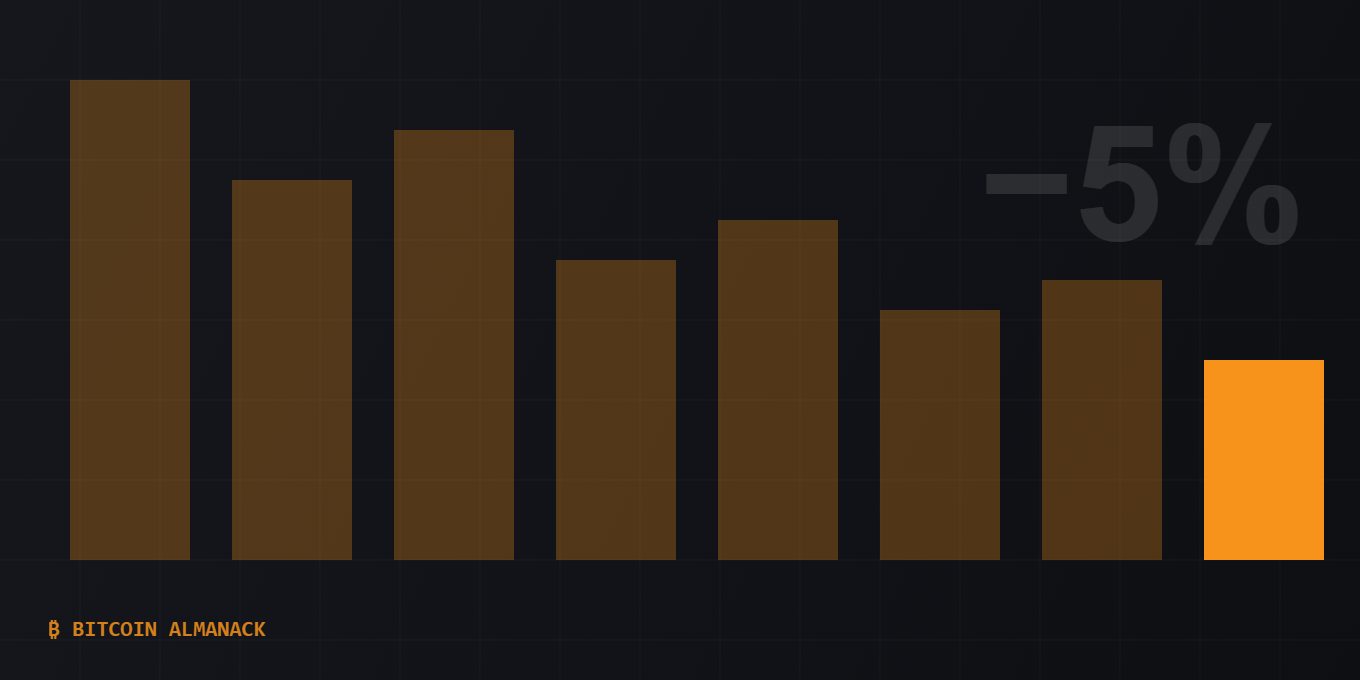
Mining difficulty fell 5% on July 11 — the third-lowest reading of 2026. Illustration: Bitcoin Almanack.
Bitcoin's mining difficulty fell 5.00% on July 11, landing at 127.17 trillion at block 957,600 — the network's 14th adjustment of 2026 and its third-lowest reading of the year. The prior two-week epoch ran long, with blocks averaging 10 minutes 32 seconds against the protocol's 10-minute target, the condition that triggers an automatic cut.
Behind the slow blocks is a fast exit. The seven-day average hashrate fell to roughly 908 EH/s by July 11, down 7.9% from about 986 EH/s on July 1 — and 21.3% below the all-time high of 1,154 EH/s set last October. Machines don't disappear for no reason: with bitcoin trading in the low $60,000s for much of the epoch, hashprice sat near gross breakeven for older rigs and higher-cost power contracts, and several public miners kept converting capacity to AI and high-performance computing contracts.
For the miners still hashing, the cut is a raise. Hashprice — expected revenue per petahash per second per day — rebounded about 12.5% to $31.10 after the adjustment, though it remains 37.2% below its October 2025 peak of $49.40. Fees offered no help: transaction fees made up just 0.69% of block rewards last week, down 18% from the week before.
The whiplash has become 2026's pattern. Difficulty fell 10.09% on June 13 — the second-largest cut of the year — rose 7.15% on June 26 as hashrate returned, then gave back 5% this round. Of the year's 14 adjustments, eight have been negative, and difficulty is down about 14.2% year-to-date. Hashrate has repeatedly found its floor in the 880–910 EH/s band.
Early signs point to another swing back: block times averaged around 9 minutes 44 seconds in the first days of the new epoch, and Luxor's Hashrate Index projects a roughly +2.7% adjustment around July 25 — an estimate that will move as the epoch matures.
BITCOIN ALMANACK ANALYSIS
2026's difficulty whiplash: five biggest adjustments (%)
−11.2
−7.8
−10.1
+7.2
−5.0
FEB 7MARJUN 13JUN 26JUL 11
8 of 2026's 14 adjustments have been negative; difficulty −14.2% YTD · Data: Galaxy Research, Hashrate Index · Chart: Bitcoin Almanack
WHY IT MATTERS
Difficulty is bitcoin's self-balancing thermostat: when miners can't make money and switch off, the network automatically makes mining easier for everyone who stays, and blocks keep flowing every 10 minutes. No committee, no bailout — the 2026 squeeze is the mechanism working exactly as designed, and it's why the network keeps running through every downturn.
What to watch next
1.The July 25 adjustment. Early block times point to a modest increase (~+2.7% per Hashrate Index) — a third straight oscillation would confirm hashrate is stabilizing in the 880–910 EH/s band rather than trending down.
2.Hashprice vs $30. Below it, older-generation machines run at a loss and more capacity switches off; sustained readings above it slow the exodus.
3.AI/HPC conversions. Quarterly reports from public miners will show how much hashrate loss is permanent repurposing rather than temporary curtailment.
Frequently asked questions
What is a bitcoin difficulty adjustment?
Every 2,016 blocks (about two weeks), the network recalculates how hard it is to mine a block so that blocks keep arriving every 10 minutes on average. If miners left and blocks ran slow, difficulty drops; if mining power grew, it rises.
Why is hashrate falling in 2026?
Two forces: bitcoin's price decline has pushed hashprice near breakeven for older machines and higher-cost operators, and several public miners are converting power capacity from mining to AI and high-performance computing contracts.
Is lower difficulty good or bad for miners?
Good for the miners still running — each unit of hashrate earns more bitcoin, which is why hashprice jumped 12.5% after the cut. But the falling difficulty itself is a symptom of stress: it only drops because other miners shut down.
SOURCES & DATA
Hashrate Index (Luxor) — weekly mining roundup, hashprice and next-epoch estimate ↗
Bitcoin.com News — July 11 adjustment data ↗
The Block / Galaxy Research — June adjustment context and AI/HPC reallocation ↗
All figures verified against source data before publication. See our editorial process.
Aisha Bennett
Mining & Hardware Editor. Licensed electrician and former power-systems engineer; every ASIC reviewed on this site hashes 30 days on her own rack, on her own power bill.
MARKET NOW
{{ price }}
{{ change }}
Hashrate{{ hashrate }}
Fees{{ fees }}
Block{{ block }}
NEW TO BITCOIN?
Curious about mining at home? Our miner reviews cover real watts, noise, and payback math.
Browse miner reviews →
© 2026 Bitcoin Almanack
AboutFAQHow we reviewAffiliate disclosureContactPrivacyTermsNewsletterSitemap
Education, not financial advice.