Michael Saylor and Strategy, explained: MSTR, STRC, STRD, STRK, and STRF
One company, 843,775 bitcoin, five tickers. Who Saylor is, what a bitcoin treasury company actually does, and how each security in the stack works.
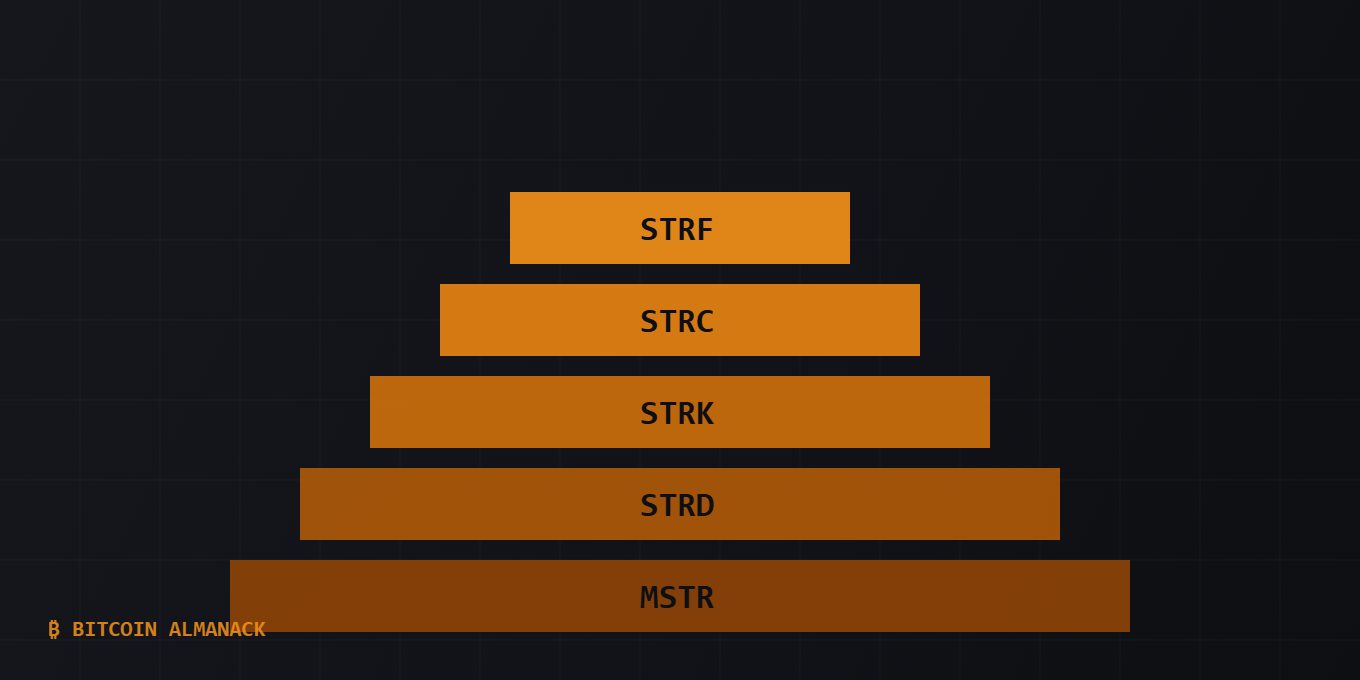
Strategy’s capital stack: four preferreds atop MSTR common. Illustration: Bitcoin Almanack.
Who is Michael Saylor?
Michael Saylor is the executive chairman of Strategy Inc. and the most visible corporate advocate for bitcoin in the world. An MIT-trained aeronautical engineer, he co-founded MicroStrategy in 1989 as a business-intelligence software company and rode it to a $7 billion paper fortune in the dot-com bubble — then lost most of it in a single day in March 2000 when the company restated its earnings and the stock collapsed. He spent the next two decades running a profitable but unremarkable software firm.
The second act began in August 2020, when Saylor announced MicroStrategy would adopt bitcoin as its primary treasury reserve asset — arguing that holding cash was "a melting ice cube" in an era of monetary expansion. The company bought 21,454 BTC for $250 million that month and never really stopped. In 2025 it renamed itself Strategy, making the pivot official: the software business still exists, but the balance sheet is the product.
What is a bitcoin treasury company?
A bitcoin treasury company is a public company whose core business is accumulating bitcoin. The playbook Saylor invented works like a loop: sell stock and debt to investors, use the proceeds to buy bitcoin, and let a rising bitcoin price lift the share price, enabling the next raise. Strategy measures itself with a custom metric — "BTC Yield," the growth in bitcoin per share — on the theory that success means each share representing more bitcoin over time, not earnings.
The model has been copied by dozens of companies worldwide, but scale separates Strategy from its imitators: as of July 12, it holds 843,775 BTC bought for roughly $63.7 billion — an average price of $75,476 per coin. With bitcoin in the mid-$60,000s, that stack is currently underwater, and 2026 has tested the loop's reverse gear: the stock is down roughly 80% from its November 2024 high of $543, and in June the company began selling bitcoin for the first time — about $218 million so far — to fund preferred dividends and rebuild a $3.0 billion cash reserve.
The five tickers
Strategy has effectively built its own capital market on top of one asset. Saylor describes it as a "bitcoin yield curve": one common stock for maximum exposure, and four preferred stocks that trade upside for dividends, each at a different rung of risk. Seniority — who gets paid first if things go wrong — runs bondholders first, then STRF, STRC, STRK, STRD, and finally MSTR common at the bottom.
BITCOIN ALMANACK ANALYSIS
The Strategy stack: five securities, one bitcoin balance sheet
TICKER
WHAT IT IS
DIVIDEND
STRF
"Strife" — the conservative one. Most senior preferred. Fixed dividend, cumulative (missed payments are still owed), cash-only.
10% fixed
STRC
"Stretch" — the money-market one. Variable rate reset monthly to hold the price near $100 par. Most bond-like; dividends accrue if missed.
~12% variable
STRK
"Strike" — the hybrid. Convertible preferred: fixed income now, plus conversion into MSTR shares if the stock ever reaches $1,000.
8% fixed
STRD
"Stride" — the risky yield. Most junior preferred, and non-cumulative: a skipped dividend is gone forever. Highest stated yield to compensate.
10% non-cum.
MSTR
The common stock. Pure leveraged bitcoin exposure — maximum upside and downside, no dividend, last claim in a liquidation.
None
Listed top-to-bottom by seniority (safest → riskiest). Rates as stated at issuance; STRC rate as of July 2026 · Data: Strategy Inc, SEC filings · Table: Bitcoin Almanack
The catch that unites all five: every dividend ultimately depends on Strategy's ability to keep raising money or, failing that, sell bitcoin. The company holds no meaningful operating income relative to its obligations — roughly $15.5 billion of preferred stock and $6.7 billion of convertible notes sit on top of the bitcoin stack. In a strong market the loop funds itself; in 2026's weak one, Strategy has leaned on stock sales ($467 million in the second week of July alone) and its first-ever bitcoin sales to cover about 20 months of dividend runway.
WHY IT MATTERS
Strategy is the largest single corporate holder of bitcoin — nearly 4% of all coins that will ever exist. Its capital machine helped drive the 2024–25 bull market, and its stress in 2026 is now a market factor in its own right: when Strategy files an 8-K, bitcoin moves. Understanding the five tickers is understanding how leverage entered bitcoin's market structure.
What to watch next
1.The Monday 8-Ks. Strategy discloses weekly activity in SEC filings — whether it's buying, holding, or selling bitcoin is now a market-moving data point.
2.Dividend coverage. The company reports its USD reserve (currently $3.0 billion, ~20 months of coverage) — a shrinking runway would force more bitcoin sales.
3.The $75,476 line. Strategy's average purchase price. Bitcoin sustained above it restores the flywheel; below it, the "sell BTC to pay dividends" era continues.
Frequently asked questions
What is a bitcoin treasury company?
A public company whose main business is holding bitcoin on its balance sheet. It raises money by selling stock and debt, uses the proceeds to buy bitcoin, and its share price trades largely as a leveraged bet on bitcoin's price rather than on any operating business.
What is the difference between MSTR and Strategy's preferred stocks?
MSTR is common stock — maximum bitcoin upside and downside, no dividend, last in line if things go wrong. STRF, STRC, STRK, and STRD are preferred stocks that pay fixed or variable dividends instead of upside; they rank above MSTR but below bondholders, in that order of seniority.
Are Strategy's preferred dividends guaranteed?
No. STRF, STRC, and STRK accrue unpaid dividends (the company still owes them later), but STRD is non-cumulative — a skipped payment is simply gone. All of them depend on Strategy's ability to keep raising capital or sell bitcoin, which it began doing in 2026.
SOURCES & DATA
SEC EDGAR — Strategy Inc 8-K filings (holdings, sales, ATM activity) ↗
Strategy Inc — STRC terms and preferred stock disclosures ↗
CoinDesk — July 2026 bitcoin sales coverage ↗
Not investment advice. All figures verified against SEC filings before publication. See our editorial process.
Marisol Vega
Markets Reporter covering bitcoin ETFs and daily news. Tracking every spot ETF flow report since the funds launched in January 2024; former wire-service markets reporter.
MARKET NOW
{{ price }}
{{ change }}
Hashrate{{ hashrate }}
Fees{{ fees }}
Block{{ block }}
NEW TO BITCOIN?
Prefer bitcoin exposure without a company in the middle? Compare spot ETFs — or learn to hold it yourself.
Compare bitcoin ETFs →
© 2026 Bitcoin Almanack
AboutFAQHow we reviewAffiliate disclosureContactPrivacyTermsNewsletterSitemap
Education, not financial advice.